
Choosing a web design agency is one of the higher-stakes decisions a business makes, and one of the least transparent. The deliverable is hard to judge before it exists, the price range is enormous, and almost every studio’s website says the same three things: “creative”, “results-driven”, “passionate”. So you end up choosing on gut feel, a nice portfolio and a number — and a year later you either have an asset that earns its keep or an expensive brochure nobody updates.
This is the guide we’d want a friend to read before signing anything. It’s written by a founder-led studio with 9+ years and 50+ projects behind us, and it’s deliberately honest about how this industry actually works — including the parts that don’t flatter agencies like ours.
First decide what you’re actually buying
Before you talk to anyone, get clear on the job. “We need a new website” is not a brief — it’s a symptom. The real question is what the site is supposed to do: book consultations, generate quote requests, sell products, replace a manual process, or simply stop embarrassing you in front of clients who already found you elsewhere.
The clearer you are on the job, the easier every later decision becomes — and the faster you’ll spot an agency that’s selling you scope you don’t need. If you can’t answer it yet, that’s fine; a good studio will help you define it. But you should walk in knowing the difference between “make it look nicer” and “make it convert”, because those two briefs cost very different money and attract very different agencies. We wrote a whole piece on that mindset: your website is a product, not a project.
The questions that actually separate agencies
Anyone can show you pretty screenshots. These are the questions that reveal whether there’s real substance behind them. Ask them directly, and pay as much attention to how they answer as to what they say.
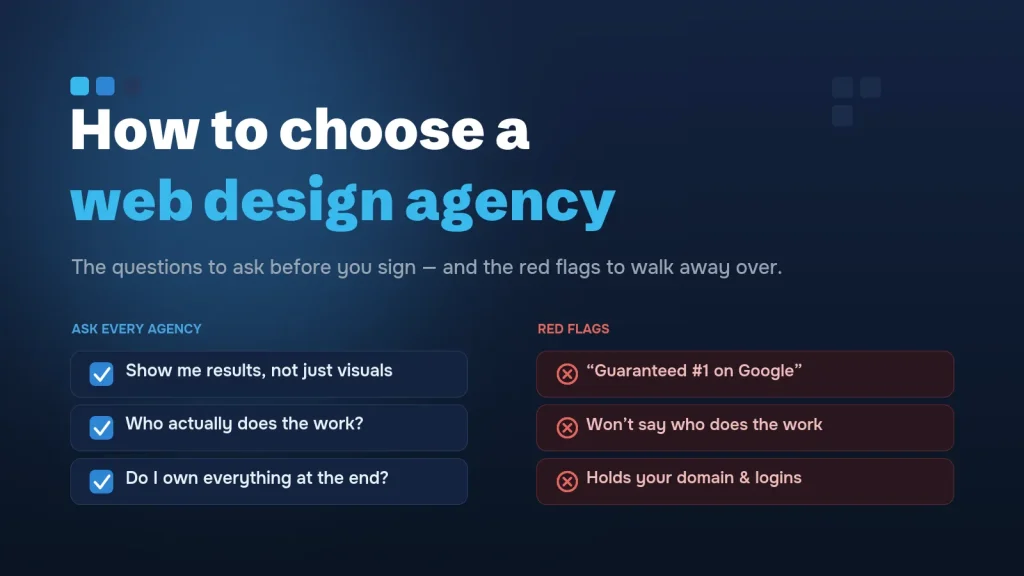
- “Can you show me results, not just visuals?” A good agency talks in outcomes — traffic, rankings, conversion rate, enquiries, revenue — not just “we made it look great.” If every case study ends at the launch screenshot, that’s a tell.
- “Who actually does the work, and will they change after I sign?” Plenty of studios sell with senior people and deliver with juniors. Ask who’s on your project, and whether the person impressing you now will still be there in month two.
- “What happens after launch?” A website isn’t finished on launch day — it’s the first version of a living product. Ask about measurement, iteration, maintenance and who owns fixing things when they break.
- “Do I own everything at the end?” You should own the domain, hosting, code, content and every account outright. If the agency holds your site hostage on their platform or logins, walk away.
- “How do you handle speed and SEO?” These are foundations, not add-ons. If the answer is vague or “we’ll install a plugin for that,” they’re decorating a house with no plumbing.
- “Can I speak to a past client?” The willingness to connect you with someone whose project has been live for a year tells you more than any testimonial slider.
Read the portfolio like a skeptic
Portfolios are curated to impress, so read them against the grain. Look for projects similar to yours in complexity, not just in looks. Open the live sites, not just the mockups — do they still exist, do they load fast, do they work on your phone? A beautiful case study for a site that’s now offline, broken or replaced tells you the agency is good at pitching and less good at shipping something that lasts.
Most importantly, look for evidence of thinking, not just styling. A studio that can explain why a layout is shaped the way it is — what decision each page is built around — is one that will design for your business, not just for their own reel. The principles behind a site that converts are the same ones a good agency should be able to articulate on demand.
How to read the price
Web quotes vary wildly for the same-sounding brief, and the number alone tells you almost nothing. Cheap can be genuinely fine for a simple template-based site — and it can also be a junior building on rented land with no strategy, no SEO and no support. Expensive can buy real strategy, custom work and a team that sticks around — or it can just be a bigger agency’s overhead.
What matters is what’s inside the number. Ask for a breakdown: strategy, design, build, content, SEO, testing, and post-launch support. A quote that itemises those is from someone who’s thought about the work. A single round figure with no breakdown is a guess — or a trap.
Red flags worth walking away over
Some warning signs are worth ending the conversation over, no matter how good the portfolio looks:
- They promise a specific Google ranking. Nobody can guarantee that; anyone who does is either naïve or lying.
- They can’t or won’t name who does the actual work.
- They own your domain, hosting or accounts “to make it easier.”
- Everything is urgent, discounted “today only”, or pressured.
- They talk only about looks and never about outcomes.
- There’s no plan — or price — for what happens after launch.
Frequently asked questions
Freelancer or agency — which should I choose?
A great freelancer can outperform a mediocre agency, and vice versa. The real question is continuity and range: a solo builder may nail the design but leave you stuck on strategy, SEO or support, and there’s key-person risk if they get busy or move on. An agency should give you a team and continuity — as long as the seniors who sold you don’t vanish after signing.
How long should a good website take?
For a serious business site, think in weeks to a couple of months, not days — and be suspicious of both extremes. A studio promising a full custom build in a few days is cutting the parts you can’t see; one quoting six months for a standard brochure site is either over-engineering or overbooked.
What’s the single most important thing to get right?
Alignment on the job. If you and the agency agree on exactly what the site is for and how success is measured, most other decisions fall into place. If you don’t, no amount of visual polish will save the project.
Where to start
You don’t have to get this perfect — you just have to avoid the expensive mistakes. Get clear on the job, ask the questions above, read the portfolio like a skeptic, and insist on owning everything at the end. Do that and you’ll filter out most of the risk before you spend a cent.
If you’d like an honest second opinion, that’s genuinely what we’re here for. See the work we’ve shipped, explore how we help, or just send us your current URL for a free 48-hour audit — no call, no pitch deck, no obligation. Even if you never work with us, you’ll walk away knowing exactly what to fix.