
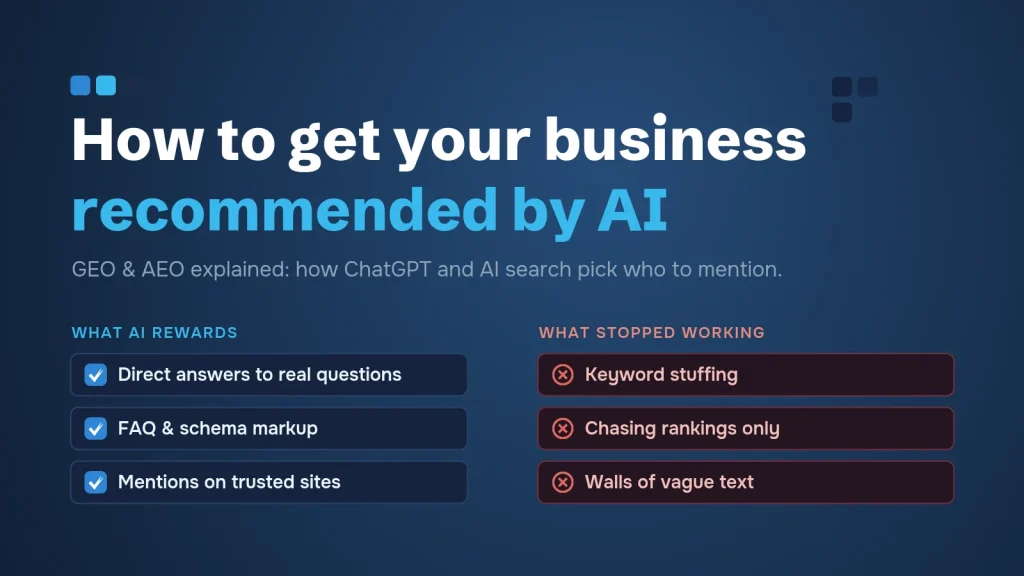
A growing share of your future customers no longer google “best web agency” and scroll through ten blue links. They ask ChatGPT. Or Perplexity, or Google’s AI Mode — and they get one synthesized answer with a handful of businesses mentioned by name. If yours isn’t one of them, you’re invisible to that buyer, and you’ll never even know the conversation happened.
The good news: most of your competitors haven’t adapted yet. AI search optimization — you’ll see it called GEO or AEO — is where classic SEO was fifteen years ago: the fundamentals are learnable, the playing field is still open, and a small business that does the basics well can genuinely outrank bigger names in AI answers. This guide covers what actually moves the needle, without the snake oil.
GEO, AEO and the acronym soup, explained
AEO (Answer Engine Optimization) means structuring your content so an AI can lift a clean, direct answer from it. GEO (Generative Engine Optimization) means making your business one of the sources an AI trusts enough to cite when it builds that answer. In practice they overlap so much you can treat them as one job: make your site the easiest credible source for an AI to quote.
One thing to get out of the way: this does not replace SEO. AI assistants lean heavily on search indexes and on content that already ranks — Gartner projects traditional search volume shrinking by about a quarter, which still leaves the large majority of it intact. You need both. Everything below strengthens your classic SEO too, so nothing here is wasted work.
How an AI decides who to mention
When someone asks an assistant “who should build my e-commerce site” or “what’s a fair price for a business website”, the model assembles an answer from sources it can read, understand and corroborate. That translates into a few concrete signals:
- Extractability. Pages that answer a question directly, in the first sentence or two under a clear heading, get quoted. Pages that bury the point under 400 words of warm-up don’t.
- Structure. Headings that sound like real questions, short sections, lists and tables — the format of a reference document, not an essay.
- Corroboration. AI systems weigh how often your brand appears across the web — reviews, directories, industry mentions, other sites referring to you. Mentions matter even when they’re not links.
- Accessibility. If your robots.txt blocks AI crawlers, or your content only exists inside JavaScript widgets and PDFs, you’ve opted out of the conversation.
The checklist: seven things that actually work
1. Lead with the answer
Under every heading, give the direct answer in the first 40–60 words, then elaborate. This is the single highest-leverage habit in AI optimization — models are built to extract exactly that kind of block. It also happens to be what impatient human readers want.
2. Build pages around questions people actually ask
Your best keyword research is your inbox: the questions prospects ask before buying are the questions they now type into ChatGPT. Google’s “People Also Ask” boxes and your sales calls are a goldmine. One clear page per real question beats one vague page “about our services”.
3. Add FAQ sections and schema markup
An FAQ block at the end of key pages gives AI pre-packaged question-and-answer pairs. Back it with structured data — FAQPage, Organization, LocalBusiness and Service schema — so machines don’t have to guess what your page is about. If your site runs on WordPress, a well-configured SEO plugin covers most of this.
4. Format like a reference, not a brochure
Descriptive headings, short paragraphs, bulleted lists, comparison tables, named numbers. AI models (and humans) trust specifics: “50+ projects over 10+ years” is quotable; “years of experience delivering excellence” is filler that no model will ever cite.
5. Don’t lock the crawlers out
Check your robots.txt for blocks on GPTBot, ClaudeBot, PerplexityBot and friends — some security and cache plugins block them by default, which is opting out of AI answers entirely. Keep the site fast and the HTML clean; content that only renders client-side is content many crawlers never see.
6. Get mentioned, not just linked
Reviews on Google and Clutch, industry directories, local listings, guest articles, podcast appearances — every credible mention of your brand teaches the models that you exist and that others vouch for you. This is the “authority” half of GEO, and there’s no shortcut for it.
7. Keep the classic foundations
Everything that made a site rank still feeds AI answers: technical health, speed, internal linking, content that converts. If you’re planning a rebuild, do it without torching what you’ve earned — we wrote a full guide on relaunching a website without losing SEO, and on building a site that converts once visitors do arrive.
One step further: putting AI to work on your site
Optimizing for AI is half the story; the other half is using it. Connecting a model like OpenAI’s GPT or Anthropic’s Claude to your own site is no longer an enterprise project: a chatbot trained on your actual pages and documents can answer pre-sales questions at 2am, qualify leads before they reach your inbox, and hand off to a human when it matters. At typical small-business volumes the API costs are in the tens of dollars a month, not thousands.
The honest caveats: a bot is only as good as the content you feed it, it needs guardrails so it doesn’t improvise answers about your prices, and anything client-facing deserves a human review loop. Done right, it turns your website from a brochure into a working employee — which is the whole point of treating your website as a product, not a project.
Frequently asked questions
Is classic SEO dead, then?
No — it’s the substrate AI answers are built on. Assistants pull heavily from content that ranks and from brands with real footprints. Think of GEO/AEO as SEO with a second audience: machines that read your site so they can speak about you.
How do I check what AI currently says about my business?
Ask it. Put your real customer questions to ChatGPT, Perplexity and Google’s AI Mode in a few phrasings and see who gets named and which sources are cited. Do it monthly — it’s the AI-era equivalent of checking your rankings, and it will show you exactly which competitor content is winning.
How long before AI starts mentioning my business?
Weeks to months, honestly — content has to be crawled, indexed and corroborated before models pick it up, and some assistants refresh faster than others. Be suspicious of anyone selling a “guaranteed spot in ChatGPT”: it’s the same lie as a guaranteed #1 on Google, which we covered in how to choose a web design agency.
Where to start
Start small and concrete: pick your five most valuable customer questions, answer each one directly on your site, add FAQ schema, check robots.txt, and go collect three honest reviews. That alone puts you ahead of most of your market.
Want to know what ChatGPT, Perplexity and Google AI Overviews say about your business today? Our AI visibility audit ($490) runs your buyers’ real questions, checks whether AI tools can crawl and quote your site, and gives you a prioritized fix list. See the work we’ve shipped or how we help.